- Mumbai Live Team
- Real Estate
Mumbai’s residential real estate market has closed FY2025-26 on a strong note, with the city (under BMC jurisdiction) registering 15,516 property transactions in March 2026, marking the highest March performance in the last 14 years, according to data released by Knight Frank India.
The surge in activity translated into stamp duty collections exceeding INR 1,492 crore, highlighting sustained buyer confidence despite evolving transaction dynamics.
On a month-on-month basis, registrations rose 19% compared to February 2026, while stamp duty collections saw an even sharper 32% increase, indicating a strong push from homebuyers to close transactions before the financial year-end.
However, on a year-on-year (YoY) basis, registration volumes remained largely stable, matching the high base of March 2025. Stamp duty collections dipped marginally by 6% YoY, suggesting a change in the overall ticket-size mix rather than a slowdown in demand.
Residential properties continued to dominate the market, accounting for nearly 80% of all registrations, reinforcing the end-user-driven nature of Mumbai’s housing demand.
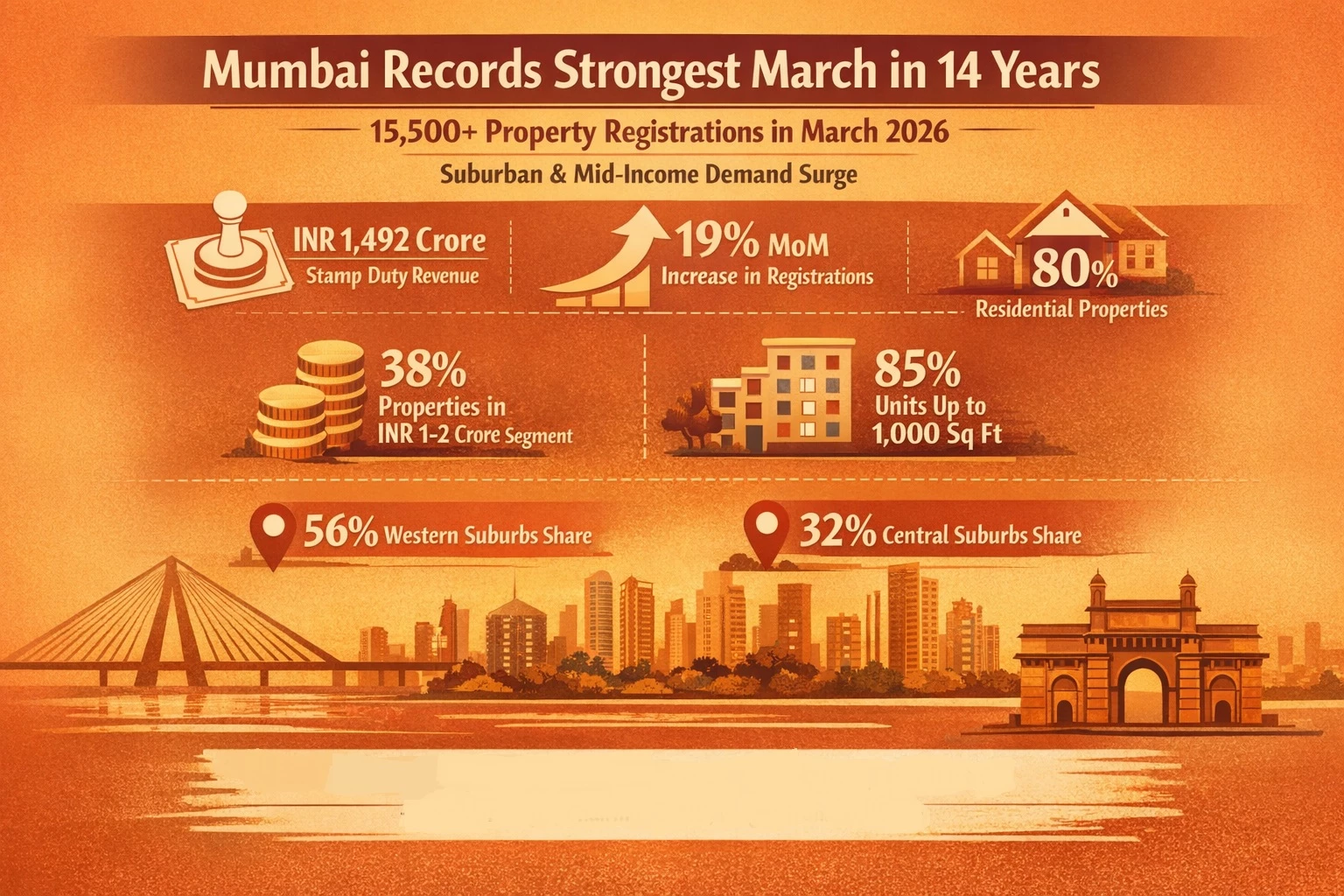
A key trend observed in March 2026 was the shift toward mid-segment housing. Properties priced between INR 1–2 crore saw their share rise significantly to 38%, up from 32% last year.
In contrast, the sub-INR 1 crore segment declined from 46% to 39%, pointing to a gradual move away from entry-level housing. Meanwhile, higher-value segments remained steady, with INR 2–5 crore and INR 5 crore+ categories holding at 17% and 6%, respectively.
Prashant Sharma, President, NAREDCO Maharashtra said: “The robust performance of over 15,500 property registrations in March 2026 reflects the underlying strength of Mumbai’s housing demand, particularly driven by end-users. The steady shift towards the INR 1–2 crore segment indicates a clear aspiration-led upgrade among homebuyers, supported by stable economic conditions and improving affordability. Continued infrastructure push and policy stability will be critical in sustaining this momentum and ensuring supply keeps pace with evolving demand patterns.”
Application-wise, the bulk of revenue came through digital platforms, with the ‘I-Sarita’ system accounting for over INR 49,500 crore, followed by adjudication services and other online mechanisms.