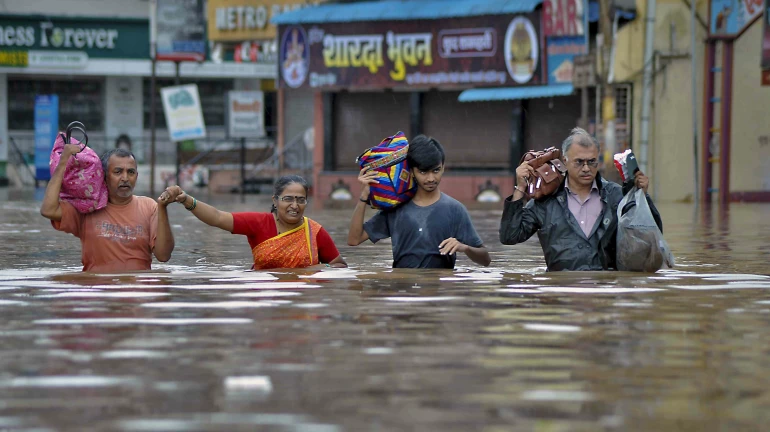


The Brihanmumbai Municipal Corporation (BMC) has prepared an integrated flood control plan worth ₹13,000 crore to provide permanent solutions to the flooding and waterlogging that Mumbai experiences every year during heavy rainfall.
Under the proposed plan, flood gates and pumping systems will be installed at 33 additional locations across the city. A state-of-the-art sensor network will also be deployed to continuously monitor water levels in rivers and major stormwater drains.
Work on the project is scheduled to begin in October 2026, with completion targeted for October 2029.
The ambitious flood mitigation project has received in-principle approval from the Central Government. Chief Minister Devendra Fadnavis recently informed the Maharashtra Legislative Assembly that a proposal seeking financial assistance has already been submitted to the Centre.
On July 26, 2005, Mumbai recorded an unprecedented 944 mm of rainfall in a single day, triggering one of the worst floods in the city's history.
Following the disaster, and based on the recommendations of a fact-finding committee, the BMC spent thousands of crores of rupees under the BRIMSTOWAD project. The works included widening and deepening stormwater drains, constructing RCC drains, rehabilitating underground drainage networks, and establishing pumping stations across the city.
Despite these efforts, the number of waterlogging hotspots has not reduced to the extent originally expected.
First Phase
The first phase of the new flood control plan will include the construction of pumping stations at Mahul and Mogra. It will also cover the installation of 18 flood gates under the third phase of the Mithi River project, along with the construction of service roads and retaining walls.
In addition, flood gates and pumping systems will be installed at 33 more locations across Mumbai. To prevent garbage from entering stormwater drains, protective mesh screens measuring 8 to 10 feet in height will be installed at selected locations.
The project also proposes special flood mitigation measures at 350 flood-prone locations throughout the city.
Doubling Drainage Capacity
Mumbai's existing stormwater drainage system is designed to drain approximately 50 mm of rainfall per hour. Under the new plan, the Municipal Corporation aims to increase this capacity to 100–120 mm per hour.
Officials expect this enhancement to significantly reduce waterlogging during periods of intense rainfall.
Smart Water-Level Monitoring System
The project also includes the installation of water-level sensors in major stormwater drains as well as the Mithi, Dahisar, and Poisar rivers.
Whenever water levels approach the danger mark, the BMC's central control room will receive an instant alert, and warning sirens can be activated where required. This will enable emergency response teams to respond more quickly and effectively.
At present, the sensor-based monitoring system is operational on a pilot basis at seven locations across Mumbai. Under the new project, the network will be expanded substantially.
Permanent Solution for Andheri Subway
The flood-prone Andheri Subway, which gets submerged almost every monsoon, has also been included in the integrated flood control plan.
The proposal includes the construction of three underground water storage tanks to prevent water accumulation in the subway. In addition, the Municipal Corporation is considering laying an alternative stormwater drain to facilitate faster drainage of rainwater.
These measures are intended to provide a permanent solution to flooding at the Andheri Subway and ensure that it remains operational even during heavy monsoon rains.


 Share
Share Tweet
Tweet