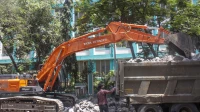
The immediate disconnection of water and electricity supply to 1,074 buildings classified as highly dangerous has been ordered by the Bhiwandi Nizampur City Municipal Corporation following the collapse of the B-wing of the Kohinoor building in Gangaram Wadi, Bhiwandi. Ten people were killed and three others were injured when the building wing collapsed on Friday. The decision to disconnect utility services was taken on Saturday during a high-level review meeting chaired by Mayor Narayan Chaudhary.
Officials were directed to act against buildings placed under the C1 and C2A classifications. A total of 238 structures have been listed under the C1 category and have been identified as requiring immediate demolition. Another 836 buildings have been classified under the C2A category and have been identified as requiring evacuation and major structural repairs.
It was directed that evacuation notices should not be issued without spot inspections being conducted by municipal officials. Temporary accommodation was also ordered to be provided in municipal buildings for occupants requiring immediate shelter. Such accommodation is to be made available for five to six days. Ward officers were further instructed to carry out surprise inspections of unsafe buildings. Night-time visits were also ordered so that unauthorised repair work in structures declared dangerous could be prevented.
Meanwhile, residents of the two wings of the Kohinoor building remained near the collapse site on Saturday. Several displaced occupants were seen waiting at a nearby temple, while others remained on roadsides or outside shops. Assistance was sought whenever civic officials, police personnel or local political representatives arrived in the area. Residents of the adjoining A-wing were permitted to enter their homes during the afternoon to retrieve essential belongings. The wing, which remained in a precarious condition, was subsequently emptied. Several tempos were stationed near the building as household goods were removed. Cupboards, beds, utensils, bags and other belongings were carried from the structure and loaded into the vehicles. Furniture, electronic appliances, clothes and important documents were among the items recovered by residents.
The movement of belongings continued during intermittent rainfall. Temporary protection was sought for the recovered items as residents attempted to arrange shelter and storage after being evacuated from the building.


 Share
Share Tweet
Tweet