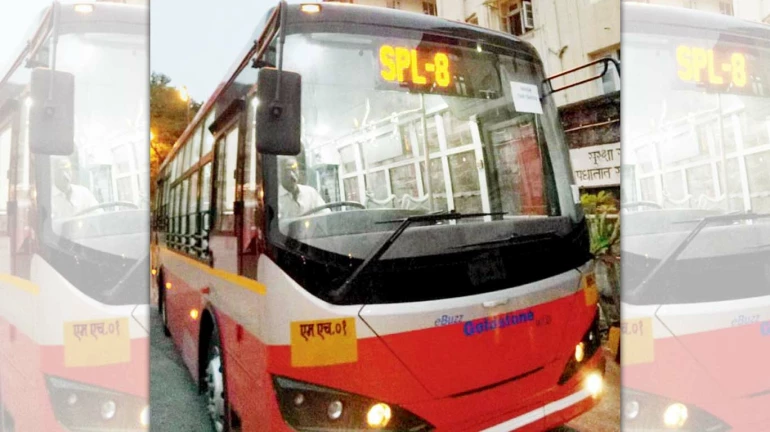


In a landmark decision that could redefine Mumbai's public transport system, the Maharashtra government has approved the Brihanmumbai Electric Supply and Transport (BEST) undertaking's proposal to procure 5,000 self-owned air-conditioned electric buses at an estimated cost of ₹6,500 crore. The move marks the biggest expansion of BEST's owned fleet in nearly a decade and signals a gradual shift away from its dependence on privately operated wet-lease buses.
The approval, granted by Deputy Chief Minister Eknath Shinde, was officially communicated to BEST during the undertaking's committee meeting on Tuesday, July 21.
Announcing the development, BEST General Manager Sonia Sethi said the undertaking will once again own its buses and recruit its own drivers, reviving the traditional operating model that served Mumbai for decades.
"The buses will be self-owned and operated by BEST drivers, as was done earlier. The procurement is estimated to cost around ₹6,500 crore," Sethi said.
The procurement of 5,000 electric buses is expected to be completed over the next three to four years and forms part of BEST's long-term vision of creating a fleet of 10,000 buses.
Officials say the transition is aimed at reducing dependence on private contractors while giving BEST greater control over operations, maintenance, safety standards and service quality. The undertaking currently operates more wet-lease buses than self-owned vehicles after years of shrinking its own fleet due to financial constraints.
The proposal also fulfils a long-pending demand of employee unions, which have consistently argued that self-owned buses offer better operational efficiency and accountability.
BEST will now prepare a financial model for the project, which is expected to be placed before the BEST Committee within the next month.
Officials are evaluating multiple funding options, including financial support from the state government, assistance from the Brihanmumbai Municipal Corporation (BMC), and raising resources independently.
Another key proposal under consideration is the redevelopment of 23 BEST bus depots spread across nearly 132 acres. Revenue generated through redevelopment could help finance the large-scale procurement.
However, the proposal has received opposition from employee unions.
BEST union leader Shashank Sharad Rao welcomed the decision to strengthen the owned fleet but opposed leasing depot land for funding.
"The BMC is already supporting the purchase of buses. We do not favour monetising BEST's depot land for this purpose," Rao said.
Along with rebuilding its fleet, BEST also plans to revive its traditional employment model by recruiting permanent bus drivers instead of relying heavily on drivers employed by private contractors.
Officials said the undertaking is exploring the possibility of absorbing experienced drivers currently working with wet-lease operators. The proposal will be examined by the Law and Judiciary Department and the Finance Department before a final decision is taken.
According to Sonia Sethi, the recruitment freeze and expansion of wet-lease operations introduced in 2019 were temporary cost-cutting measures adopted during a period of severe financial stress.
"BEST now intends to gradually reverse many of those decisions and return to its earlier operating structure," she said.
Officials believe that employing its own trained workforce will improve driver discipline, maintenance standards, operational accountability and passenger safety.
Despite the policy shift, BEST will continue with the induction of 1,500 air-conditioned electric midi buses under the wet-lease model.
The BEST Committee recently approved the project under a 12-year Gross Cost Contract (GCC) at ₹60.25 per kilometre through the Centre's PM e-Drive scheme.
The 9-metre electric buses are expected to enter service next year and will primarily operate as feeder services connecting residential areas with Metro stations and suburban railway stations.
Under the GCC model, private operators will supply, maintain and charge the buses, while BEST will continue to determine routes, schedules and passenger fares.
Officials clarified that the wet-lease buses are part of an ongoing contract and that, beyond the PM e-Drive scheme, the undertaking intends to prioritise procurement of its own buses.
BEST currently operates around 2,800 buses. The undertaking aims to increase its operational fleet to 5,000 buses over the next three years before expanding further to around 7,000 buses by 2027.
Its long-term vision is to operate nearly 10,000 buses to meet the mobility needs of Mumbai's rapidly growing population.
Officials say a larger electric fleet will improve connectivity, reduce emissions and help strengthen public transport across the city.
The expansion plans come even as BEST continues to face significant financial challenges.
As of March 31, 2026, the undertaking's cumulative liabilities stood at ₹23,296 crore. While the electricity division reported a surplus of ₹115 crore during the 2025-26 financial year, the transport division registered a deficit of ₹1,805 crore.
Despite these financial pressures, officials believe that rebuilding a predominantly self-owned electric fleet will improve operational efficiency, strengthen accountability and restore public confidence in BEST services.
The decision also follows heightened public concern over a series of accidents involving wet-lease buses, with officials emphasising that the renewed focus on self-owned buses is intended to enhance safety, reliability and commuter confidence while modernising Mumbai's public transport network.


 Share
Share Tweet
Tweet