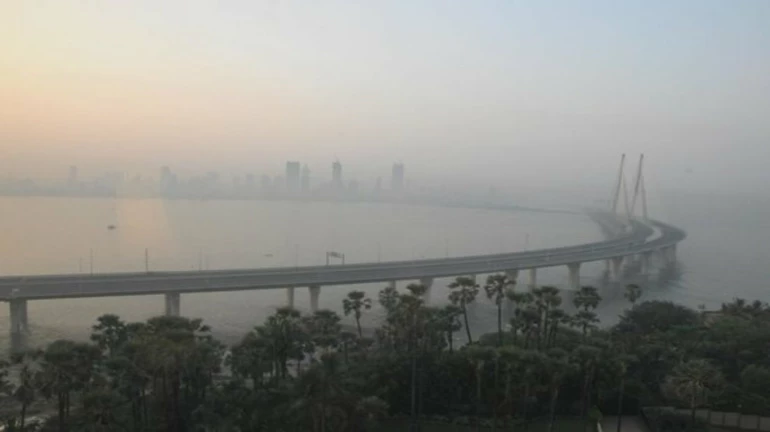


Mumbai has been ranked 37th among cities with a population of more than one million in the Swachh Vayu Sarvekshan 2026, placing it behind Delhi and several other major Indian cities in the latest assessment of efforts to tackle air pollution.
The rankings were announced during Swachh Vayu Diwas 2026, organised by the Union Ministry of Environment, Forest and Climate Change on September 7 to mark the International Day of Clean Air for Blue Skies.
While Mumbai secured the 37th position, Lucknow emerged as the best-performing million-plus city, scoring 198 out of 200 points. Indore finished second, followed by Jabalpur, while Bhopal and Agra shared the fourth position.
Mumbai's position highlights the gap between the city's ongoing pollution-control initiatives and the performance of several other cities covered by the survey.
It also places the city below several other large urban centres, indicating room for improvement in the city's pollution-control measures.
The Swachh Vayu Sarvekshan does not simply rank cities according to their daily Air Quality Index (AQI). Instead, it evaluates the steps taken by civic and government authorities to control air pollution.
The assessment covers areas such as:
Mumbai, therefore, faces the challenge of strengthening its implementation across multiple areas if it is to improve its position in future editions.
In the latest million-plus city rankings, Delhi was placed 30th, seven positions ahead of Mumbai. Bengaluru ranked 41st.
The results offer an interesting comparison because Delhi is widely associated with severe winter pollution and regularly experiences hazardous air-quality conditions. However, the Swachh Vayu Sarvekshan measures pollution-control action and institutional performance rather than ranking cities purely by their ambient pollution levels.
Although Mumbai did not make the top 10, Maharashtra recorded a strong overall showing in the 2026 survey.
Thane secured 7th position among cities with populations above one million, while Navi Mumbai ranked 9th and Nagpur finished 10th.
Pune was placed 12th, while Chhatrapati Sambhajinagar ranked 16th.
Amravati also performed well in the 3 lakh to 10 lakh population category, finishing third and receiving a ₹25 lakh award.
The performance of Thane and Navi Mumbai is particularly notable given their proximity to Mumbai and their shared challenges involving transport emissions, construction activity, road dust and urban expansion.
The Swachh Vayu Sarvekshan was introduced during 2022-23 to evaluate and rank cities on the measures they undertake to improve air quality under the National Clean Air Programme (NCAP).
For the 2026 assessment, 130 NCAP cities across 24 states and Union Territories were evaluated under three population categories:
The evaluation process included city-level self-assessment, scrutiny by State-level Monitoring Committees, assessment by the Central Pollution Control Board and field verification by independent teams.
The 2026 survey also highlighted progress in particulate pollution control across NCAP cities.
Between the 2017-18 baseline and 2025-26, 108 of the 130 cities recorded an improvement in PM10 concentrations. Among them, 72 cities achieved a reduction of more than 20%, while 26 recorded reductions exceeding 40%.
Fourteen cities also met the National Ambient Air Quality Standards (NAAQS).
The Centre has provided a performance-linked grant of ₹16,425 crore to the 130 NCAP cities to support pollution-control measures and strengthen infrastructure.
Mumbai's 37th position shows that the city has considerable scope to strengthen its performance in future Swachh Vayu Sarvekshan rankings.
For a rapidly expanding metropolitan region, controlling road dust, vehicle emissions, construction pollution and waste-related emissions will remain critical. The performance of neighbouring cities such as Thane and Navi Mumbai also suggests that stronger local interventions can translate into significantly better rankings.
The survey's findings reinforce a broader point: cleaner air depends not only on pollution levels but also on how effectively cities implement measures to reduce emissions and manage pollution sources.


 Share
Share Tweet
Tweet