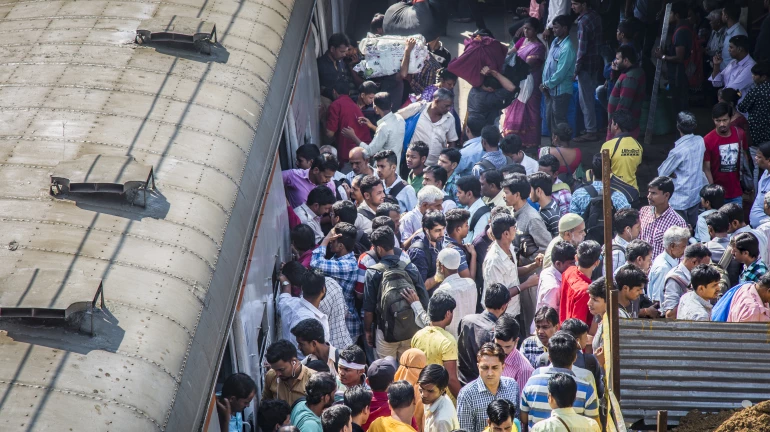


Mumbai’s suburban railway network witnessed a decline of 44.65 lakh passengers between April and June 2026 compared with the same quarter last year, as Metro services expanded across corridors that overlap with parts of the suburban rail network.
According to an internal performance assessment prepared by Western Railway’s Mumbai Central Division, total suburban passenger traffic fell by 1.71%, from 26.04 crore passengers in April-June last year to 25.60 crore during the same period this year.
The analysis identifies growing Metro connectivity as one possible factor behind the decline, particularly on routes around Borivali-Dahisar and Andheri. However, the available data does not establish how many railway commuters actually switched from local trains to Metro services.
Second Class coaches, which makes up the largest share of suburban railway travel, recorded a noticeable decline during the quarter.
Second Class passengers fell by around 3%, dropping from 21.94 crore to 21.28 crore. First Class ridership declined even more sharply, falling 7.23% from 2.74 crore to 2.54 crore.
The trend was different for AC suburban services.
AC journey and season ticket passengers rose from approximately 1.37 crore to 1.78 crore, an increase of nearly 41 lakh passengers or around 30%.
However, the increase in AC travel does not necessarily mean that all of these passengers were new additions to the suburban railway network. Some commuters who previously travelled in First or Second Class may have upgraded to AC services. Since the railway's data does not follow individual commuters across different ticket classes, the extent of such movement cannot be determined.
The Western Railway assessment has drawn attention to the growing presence of Metro services along routes traditionally served by suburban trains.
The Yellow and Red Metro lines, which operate parallel to sections of the Borivali-Dahisar route, reportedly recorded around 2.26 crore passenger rides between April and June, with an average of about 2.48 lakh rides per day.
The Aqua Line, which provides an alternative for commuters travelling along parts of the Andheri-Colaba corridor, recorded approximately 1.65 crore rides during the same period, averaging nearly 1.82 lakh rides a day.
Combined, the two Metro corridors accounted for about 3.91 crore rides during the quarter.
However, the Metro figures referred to in the railway analysis were sourced from media reports rather than official Metro data. As a result, they cannot be directly compared with Western Railway's internal passenger figures to determine the exact impact on local train ridership.
Andheri has emerged as one of the stations showing a significant drop in conventional suburban railway ticket sales.
First Class journey ticket sales at Andheri declined by 15.02%, while Second Class journey tickets fell by 6.51%.
The railway assessment suggests that some passengers travelling towards destinations such as Colaba and Siddhivinayak Temple may be opting for Metro services, including the Aqua Line.
While the station-level trends indicate increased competition from Metro connectivity, the data does not conclusively prove that these passengers have shifted from local trains to Metro services.
Several stations along or near the Metro-affected corridors recorded substantial drops in suburban railway ticket sales.
For First Class journey tickets, the decline was particularly pronounced at:
Mahalaxmi and Prabhadevi also reported significant reductions in First Class season ticket sales. Mahalaxmi recorded a 28.17% decline, while Prabhadevi saw a 27.72% drop.
The fall was also visible in Second Class ticket sales. Second Class journey tickets declined by 19.46% at Mahalaxmi and 23.02% at Prabhadevi.
Second Class season ticket sales at the two stations dropped by 26.70% and 26.57%, respectively.
While conventional suburban services saw declines, AC local trains recorded strong growth at several stations.
Lower Parel registered a striking 175% increase in AC journey ticket sales, followed by:
Goregaon also recorded a 164.50% rise in AC season ticket sales.
The figures indicate a growing demand for more comfortable suburban travel, even as overall railway passenger numbers remain under pressure.
The latest figures highlight a significant shift in Mumbai's urban mobility landscape.
Mumbai's suburban railway continues to carry the vast majority of daily commuters, but the expansion of Metro services is giving passengers more options on several important corridors. At the same time, the sharp growth in AC local travel suggests that comfort, convenience and travel experience are becoming increasingly important factors for commuters.
For Western Railway, the challenge is therefore twofold: retaining passengers in the face of growing competition while expanding services that match changing commuter expectations.
Western Railway Chief Public Relations Officer Vineet Abhishek said the passenger data reflects evolving mobility preferences. According to the railway, while overall suburban journeys declined by about 1.7%, AC suburban services grew by around 30%, pointing to increased demand for more comfortable travel.
The railway said it is monitoring changing passenger patterns and will continue to adjust its services and resources according to commuter requirements.


 Share
Share Tweet
Tweet