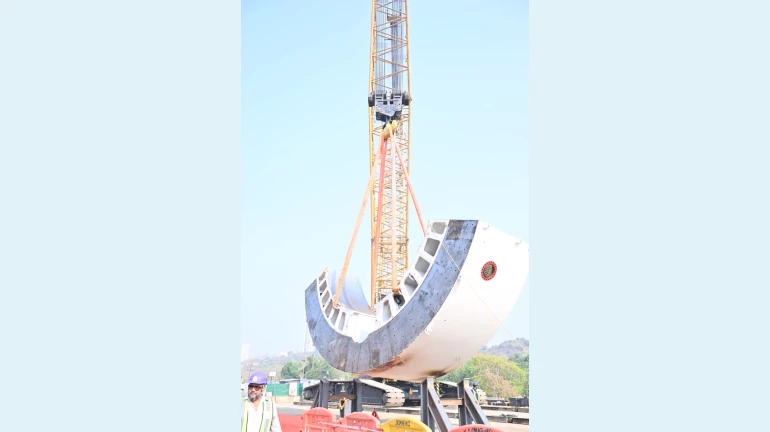


The process of lowering the components of the Tunnel Boring Machine (TBM) into the shaft for the construction of twin tunnels under Phase 3-B of the Goregaon–Mulund Link Road (GMLR) Project began formally on March 11, 2026 at the Dadasaheb Phalke Chitranagari area.
As this process has started three months ahead of the scheduled timeline, it will help accelerate the overall progress of the project. the Brihanmumbai Municipal Corporation (BMC) Commissioner Bhushan Gagrani visited the site and inspected the work. This important milestone will soon speed up the actual tunnel excavation work.
To improve road connectivity between the western and eastern suburbs of Mumbai, the BMC is implementing the 12.20-kilometre Goregaon–Mulund Link Road project. As part of this project, a twin underground tunnel will be constructed from Dadasaheb Phalke Chitranagari in Goregaon (West) to Khindipada in Mulund (East). These parallel tunnels will each be 4.70 km long.
Each tunnel will have a diameter of 14.20 metres, which will reduce to 13 metres while passing beneath the Sanjay Gandhi National Park area. These environmentally sensitive tunnels will pass entirely underground beneath the hills of the national park. Each tunnel will have three traffic lanes. The tunnels will also include systems for ventilation, modern fire-safety systems, stormwater drainage, and utility ducts for other services. Excavation will be carried out using Tunnel Boring Machines (TBMs).
Two TBMs, S-118 and S-119, manufactured by Terratec, each weighing 2,175 metric tonnes and having a diameter of 14.49 metres (the largest used in Mumbai so far) will be deployed for the project.
The launching shaft required for the twin tunnel construction at the Dadasaheb Phalke Chitranagari site has completed its first phase of work. The shaft measures approximately 200 metres in length, 50 metres in width, and 30 metres in depth. Excavation required for lowering the TBM into the shaft has been completed.
Additionally, a strong curved concrete cradle measuring 20 m × 20 m × 2.5 m has been constructed at the bottom level of the shaft. This cradle plays a crucial role in safely stabilising the TBM and ensuring its correct directional launch at the start of the excavation process. The cradle construction necessary for commissioning the TBM has also been successfully completed.
Starting on March 11, 2026, the lowering of TBM components into the shaft has begun with great enthusiasm. For this operation, advanced cranes with capacities of 800 metric tonnes and 350 metric tonnes are deployed at the site, and their required load tests have already been successfully completed. Using these cranes, various TBM components are being lowered safely into the shaft in phases.
Today, a 135-metric-tonne Type-A Shield, which is the main cutting component of the TBM, was successfully lowered.
Key technical components of the TBM including the Main Shield, Cutter Head, Screw Conveyor, Main Bearing, and Erector have already been assembled earlier. In the next stage, these components will be lowered into the shaft to build the final structure of the TBM, after which the actual tunnel excavation work will begin.
After completing the underground tunnel excavation from Dadasaheb Phalke Chitranagari / Sanjay Gandhi National Park area to Mulund – Amar Nagar, the TBM will emerge at the Retrieval Shaft in Mulund – Amar Nagar, where it will be brought to the surface and disassembled.
Also Read: Maharashtra Cracks Down on Illegal Bike Taxis in Mumbai


 Share
Share Tweet
Tweet