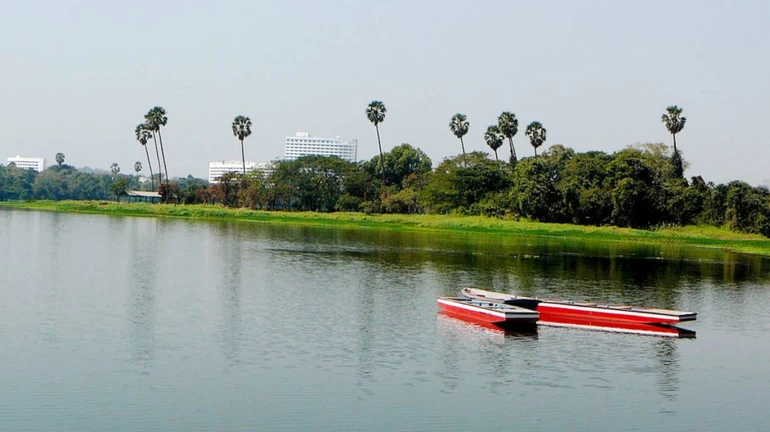


Opposition has been raised by residents of Powai’s Hiranandani township against a proposed Development Plan (DP) road that could pass through Pramod Mahajan Garden, with concerns being expressed over the potential loss of trees and green cover in the six-acre urban forest. The proposed 13.4-metre-wide road has been part of Mumbai’s Development Plan since 2018. However, residents said its alignment was brought to their attention only recently after officials from the Brihanmumbai Municipal Corporation’s (BMC) garden department visited the site to assess trees that could be affected.
More than 500 residents have submitted representations to the BMC, while over 4,000 others have signed letters opposing the alignment. Around 35 housing societies in Hiranandani township have also approached the civic body, seeking alternatives that would protect the garden. Around eight metres of the proposed road is expected to pass through Pramod Mahajan Garden, while the remaining stretch would cross an adjoining plot owned by Supreme Infrastructure India Ltd, where a commercial Global Capability Centre is being developed. Residents have questioned whether the proposed alignment is primarily intended to facilitate the adjoining commercial development.
Objections to the alignment have also been raised by Supreme Infrastructure India Ltd. Vikram Sharma, managing director of the company, said alternatives had been suggested, including shifting the road to another side of its property where the forest would not be affected and exploring the possibility of constructing a tunnel. He said connectivity could be provided without cutting through the forest.
Environmental concerns have also been highlighted by residents, who said the garden plays an important role in rainwater absorption and groundwater recharge. Shobha Philip, secretary of Lake Castle, said the natural gradient of the area and surrounding hills allowed rainwater to percolate into the soil. It was warned that reducing green cover and increasing concretisation could affect water discharge and potentially worsen flooding during heavy rainfall. The ecological value of the garden has also been cited in the objections. Around 15,000 trees representing 105 species are said to be present, including Indian Oak, Mahogany, Flame of the Forest and Baobab. Bird species such as the Eurasian Golden Oriole, Black Drongo and Asian Koel are also found in the area.
The BMC has meanwhile undertaken an assessment to determine the potential impact of the proposed road. A preliminary inventory conducted by the garden department has identified around 122 trees in the section through which the road is expected to pass. Civic officials, however, have clarified that the survey was conducted following objections received from residents and should not be interpreted as an indication that construction is imminent. The assessment was undertaken to understand the possible impact of the road on the garden.
With opposition growing across Hiranandani township, alternative alignments are now being sought by residents to ensure that connectivity requirements can be addressed without significantly affecting Powai’s existing green cover.


 Share
Share Tweet
Tweet