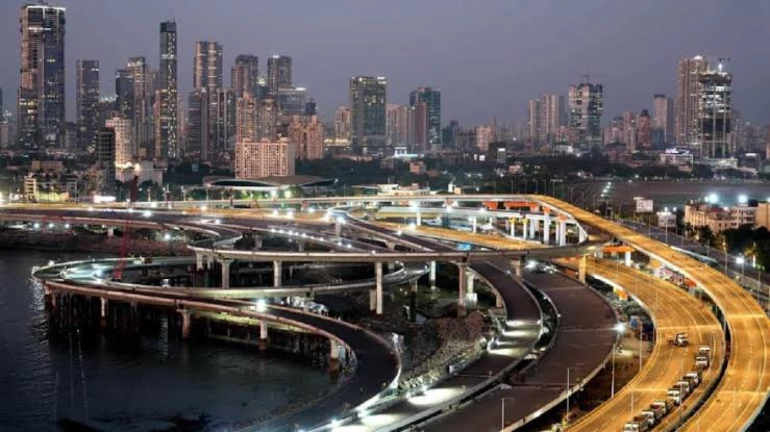


Construction on the final leg of Mumbai’s ambitious Coastal Road (North) project is being accelerated, even as substantially higher traffic volumes are being recorded on the already operational southern section following the introduction of round-the-clock access. The northern corridor, which is planned to extend connectivity towards Bhayandar, is being targeted for completion by December 2028.
Foundation work on the Dahisar-Bhayander Link Road (DBLR) section has been taken up, with piling and pile-cap construction currently being carried out. Launching-girder operations are expected to be started in the second week of October. To support faster construction, a dedicated casting yard has been established at Bhayander, where precast concrete components required for the elevated structures are being manufactured.
According to information provided by the BMC’s Bridge Department, 60 piles, five pile caps, four piers, pier caps and nine bridge segments have already been completed. Advanced construction equipment has been installed at the site, while a temporary access bridge has also been made operational to support project activity.
The Bhayander casting yard was inspected by Additional Municipal Commissioner (Projects) Abhijit Bangar, during which manufacturing operations, construction progress, quality-control procedures, machinery and safety arrangements were reviewed. Officials were directed to prioritise critical land parcels so that acquisition could be accelerated. Greater coordination with the Mira-Bhayandar Municipal Corporation and other agencies was also sought. Strict compliance with safety procedures, appropriate barricading and timely execution without compromising construction quality were emphasised.
The wider Coastal Road (North) project is planned across approximately 60 km, including interchanges and connecting roads, through which Versova and Bhayandar are expected to be linked. Seven packages—A, B, C, D, E, F and DBLR—have been created for its implementation. The DBLR portion extends for about 5.135 km and incorporates elevated roads, stilt-supported sections through mangrove areas, creek crossings, structures over salt-pan land, connector roads, flyovers and interchanges.
A 3.83-km-long and 45-metre-wide elevated main road is being developed as the final stretch of the corridor. Once the larger connection is completed, travel time between Versova and Bhayandar is expected to be reduced from the existing 90–120 minutes to approximately 15–20 minutes. An estimated Rs 20,000 crore is expected to be spent on the overall project.
Meanwhile, a sharp increase in vehicle usage has been recorded on the southern section of the Mumbai Coastal Road since 24×7 operations were introduced on August 15, 2025. Before round-the-clock access was permitted, the road was operated for about 16 hours daily and an average of 34,538 vehicles was recorded each day. After unrestricted operations were introduced, average daily usage increased to 62,640 vehicles, representing growth of nearly 81%.
A similar trend has been reflected in monthly traffic. Before August 15, 2025, approximately 11.35 lakh vehicle movements were being recorded every month. Following the transition to continuous operations, the monthly average increased to nearly 18.79 lakh movements, reflecting growth of about 66%. Since the first stretch was opened in March 2024, approximately 4.11 crore vehicles have been recorded on the southern section.
The higher figures indicate that usage had partly been constrained by the earlier operating hours and that additional demand was unlocked once overnight access was provided. However, the increase has not yet resulted in traffic reaching the levels originally projected when the Rs 13,984-crore southern project was planned. Questions over accessibility have also remained, particularly because public transport connectivity on the corridor continues to be limited.
As work towards Bhayandar is accelerated, the experience of the southern section is therefore likely to remain significant. While considerable time savings and improved road connectivity are expected to be delivered by the expanding coastal corridor, its wider impact will also be shaped by how effectively the infrastructure is integrated with Mumbai’s broader transport network.


 Share
Share Tweet
Tweet