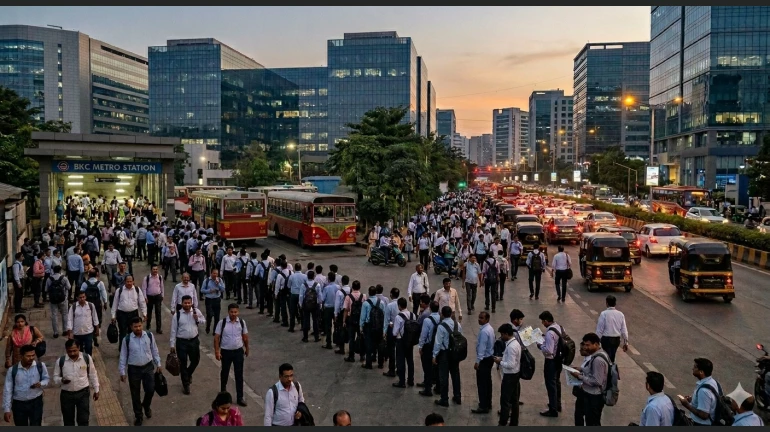


The recent launch of the Mumbai Metropolitan Region Development Authority's (MMRDA) "BKC Weekly Public Transport Day" initiative has reignited an important conversation around sustainable urban mobility. While the objective of encouraging commuters to shift from private vehicles to public transport has received broad support, the initial response from office-goers in Bandra-Kurla Complex (BKC) has highlighted a persistent challenge, the last-mile connectivity. Many commuters cited inadequate feeder services, limited mobility options between transit stations and workplaces, and concerns around convenience as key reasons for continuing to rely on private vehicles.
As one of Mumbai's most prominent business districts, BKC attracts nearly two lakh commuters daily. Despite significant investments in metro, rail, and road infrastructure, the gap between major transit hubs and final destinations remains a critical hurdle in achieving meaningful modal shifts toward public transport. Reports from the first Public Transport Day indicate that many commuters found the transition difficult due to limited last-mile options, long walking distances, and insufficient feeder connectivity.
Sharing his experience, one of the daily commuters to BKC said, "The initiative is a step in the right direction, but last-mile connectivity remains a challenge. Reaching the office from the station can be time-consuming, especially during peak hours. Better feeder services and seamless connectivity will encourage more people to choose public transport over private vehicles."
Meanwhile, industry experts believe that solving this challenge requires a combination of technology-driven mobility infrastructure, intelligent parking management, and seamless multimodal integration.
According to urban mobility experts, transit-oriented development cannot be successful through mass transit investments alone. Global cities have demonstrated that seamless integration between public transport and localized mobility infrastructure is essential to reduce private vehicle dependency and improve commuter adoption. Research studies have also highlighted that efficient first- and last-mile solutions significantly increase public transport usage and overall system efficiency.
Experts also believe that upcoming infrastructure initiatives, including enhanced metro connectivity and proposed advanced mobility systems in BKC, offer an opportunity to address these challenges more comprehensively. However, they emphasize that infrastructure projects must be supported by integrated planning focused on commuter convenience, accessibility, and last-mile efficiency to achieve their intended outcomes.
As Mumbai continues its journey toward becoming a more sustainable and transit-oriented city, the lessons emerging from BKC's Public Transport Day underscore a clear message – improving last-mile connectivity will be critical in determining whether public transport becomes the preferred choice for daily commuters.


 Share
Share Tweet
Tweet