

Mumbai's daily commute is often defined by long traffic snarls, especially across its eastern suburbs. To ease congestion and improve connectivity, the Brihanmumbai Municipal Corporation (BMC) has announced revised completion timelines for two long-awaited infrastructure projects—the Vidyavihar Railway Over Bridge (ROB) and the Mankhurd-Maharashtra Nagar Flyover.
The updated deadlines were announced after Additional Municipal Commissioner (Projects) Abhijit Bangar, along with a civic team, reviewed the progress of both projects.
After decades of planning and several construction delays, the Vidyavihar ROB is finally nearing completion. The BMC has set August 31, 2026, as the target date for opening the bridge to the public.
Originally proposed in the BMC's Development Plan in 1991, the project remained on paper for years before tenders were floated in 2016. Since then, construction has faced multiple technical and logistical challenges, pushing back its completion.
According to civic officials, nearly 80% of the work has already been completed. The 650-metre-long, four-lane bridge, being built at an estimated cost of ₹178 crore, will connect Lal Bahadur Shastri (LBS) Marg on the eastern side with Ramkrishna Chemburkar Marg on the western side by passing over the railway tracks.
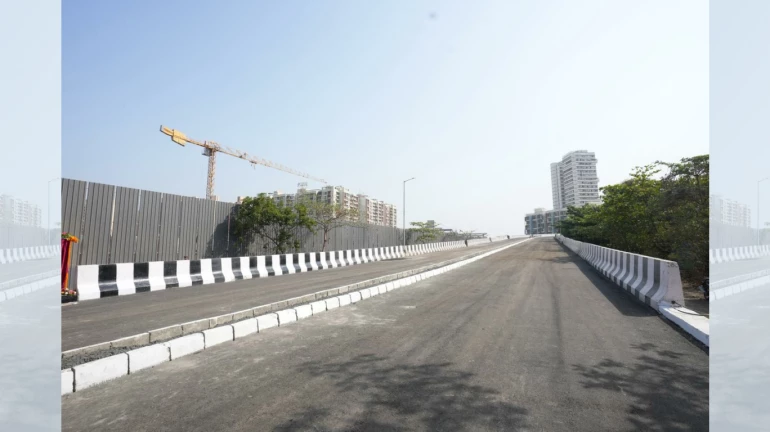
The structure includes a 100-metre steel girder section above the railway tracks, a 220-metre eastern approach road, and a 330-metre western approach road. Work on anti-crash barriers, streetlights, girder launching, deck sheeting and deck slab construction is currently underway, with some activities dependent on weather conditions during the monsoon.
At present, commuters travelling between the eastern and western sides of Vidyavihar are forced to take a lengthy detour that can take 40 to 45 minutes during peak traffic hours.
Once operational, the new bridge is expected to cut the journey down to 10–15 minutes, offering a much faster east-west connection while also reducing pressure on the Santacruz-Chembur Link Road (SCLR).
Speaking after the inspection, Additional Municipal Commissioner Abhijit Bangar said the bridge would transform connectivity in the area and provide much-needed relief to daily commuters.
The project also focuses on improving pedestrian movement. A direct connection from the flyover to the railway station footpaths is being developed, along with an additional pedestrian link connecting the station premises to nearby roads.
As part of the project, 213 trees were affected. Civic authorities said 77 trees were removed, 85 were transplanted, while 51 trees were retained at their original locations.
In addition, railway ticket counters on both sides of Vidyavihar station, the station master's office and staircases connected to the existing foot overbridge have been reconstructed as part of the associated works.
The BMC has also announced a revised timeline for the Mankhurd-Maharashtra Nagar Flyover, another key infrastructure project aimed at tackling one of Mumbai's busiest traffic bottlenecks.
While some officials indicated an August 2027 completion target, the latest directions issued during the inspection have set May 31, 2027, as the deadline for completing both flyover arms. Officials have been instructed to deploy additional manpower and machinery to meet the schedule.
The project, estimated to cost ₹1,958 crore, is designed to ease congestion at the busy Maharashtra Nagar T-Junction on the Sion-Panvel Highway, a critical route connecting Mumbai with Navi Mumbai and Pune.
The new structure will comprise two separate flyover arms that will connect directly to the existing Ghatkopar-Mankhurd Link Road (GMLR) Flyover.
Each flyover arm will feature two carriageways with widths ranging from 6.5 metres to 8.5 metres.
Currently, motorists often spend more than 15 minutes navigating the Maharashtra Nagar junction during peak hours due to heavy traffic moving between Mumbai, Navi Mumbai and Pune. Once completed, the flyover is expected to significantly reduce congestion, improve traffic flow and shorten travel times for thousands of daily commuters.
With both projects progressing steadily, Mumbai's eastern suburbs are set to receive a major infrastructure upgrade that promises smoother connectivity, shorter travel times and long-awaited relief from chronic traffic congestion.


 Share
Share Tweet
Tweet