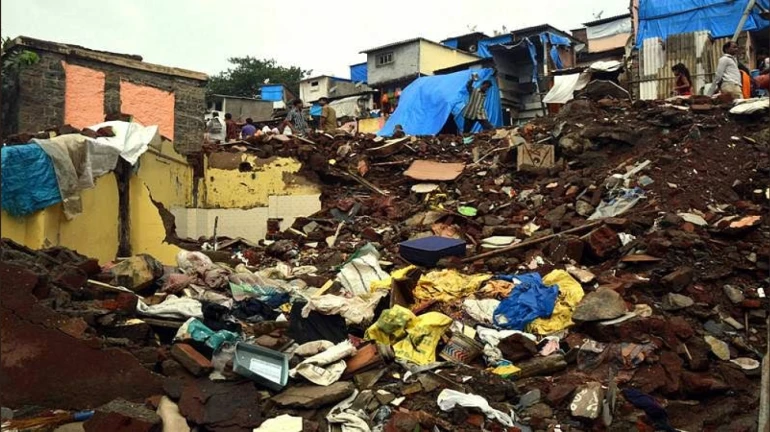


At least 44 highly vulnerable landslide-prone locations in Mumbai remain without adequate stabilisation work, leaving hundreds of residents exposed to potential slope failures during heavy rainfall. Of these, 38 are located in the suburbs and six in the island city.
The locations are part of 249 landslide-prone sites identified by the Geological Survey of India (GSI) during its 2017-18 assessment. The survey classified 74 locations as vulnerable, 46 as highly vulnerable and 129 as low-risk.
The scale of the risk has come under renewed scrutiny following the August 13 landslide in Ashok Nagar, which claimed eight lives and injured seven people. Notably, the Kurla landslide site mentioned in earlier reports was not among the 46 locations classified as highly vulnerable in the original GSI list.
A recent GSI reassessment of 32 highly vulnerable locations found that most continue to face conditions broadly similar to those recorded in the earlier survey. The assessment was carried out from May 4 to 14, with GSI officials conducting field inspections alongside Brihanmumbai Municipal Corporation (BMC) representatives.
The study examined slope stability, rock and soil conditions, drainage systems, existing retaining structures, protective measures and the proximity of residential settlements to vulnerable slopes. It also considered the possibility of slope failures during exceptionally heavy rainfall.
Four additional locations were examined as part of the latest exercise: Tulshet Pada and an area near the water pipeline in Bhandup West, Netaji Nagar in Kurla and the Radha Krishna Temple area at Khindi Pada in Bhandup West.
While mitigation work has improved conditions at one or two locations, the report noted that several sites still require existing protective measures to be strengthened or modified. Additional remedial work has also been recommended at a number of locations.
The GSI has warned that even sites currently classified as having low vulnerability may retain some risk because of poor drainage, incomplete mitigation, settlements close to slopes and smaller unstable sections.
A major hurdle in tackling the problem is that several agencies have jurisdiction over the affected land. Many of the vulnerable sites fall under the suburban district collector, making it difficult for the BMC to directly undertake permanent stabilisation work.
The collector had appointed IIT Bombay in 2021 to assess the landslide-prone locations. Subsequently, the Public Works Department prepared a detailed project report during 2022-23 for slope stabilisation at 40 suburban sites, along with rehabilitation of residents living in vulnerable areas.
However, implementation has remained slow, largely because of questions over land ownership, funding responsibilities and the relocation of residents.
A key challenge is that stabilisation work may require access through residential properties. In some locations, engineers may need to drill into slopes from within household premises to install protective nets, making rehabilitation or temporary relocation essential before work can begin.
Of the 46 locations originally categorised as highly vulnerable, mitigation work has been carried out at only two sites in recent years — Surya Nagar in Vikhroli and Sonia Gandhi Nagar in Aslfa, Kurla.
At both locations, geo-netting was used to strengthen and stabilise the slopes. Although the BMC recommended the work, it was executed by the Maharashtra State Road Development Corporation (MSRDC), which has specialised expertise in such slope-protection projects.
The BMC has also sought reimbursement from the state government for money spent on these works. Former civic chief Bhushan Gagrani wrote to the state seeking reimbursement, and the matter was subsequently followed up by his successor Ashwini Bhide.
The latest GSI assessment has called for a combination of immediate maintenance and long-term engineering measures. Its recommendations include:


 Share
Share Tweet
Tweet