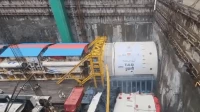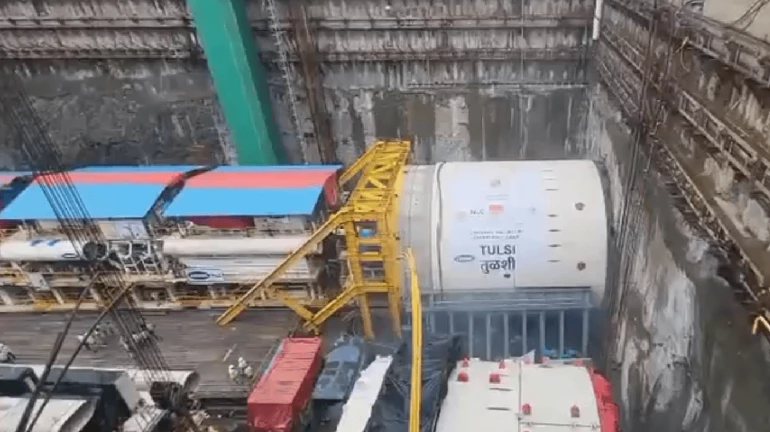


The Brihanmumbai Municipal Corporation (BMC) has commenced excavation work for the first of two major tunnels under the Sanjay Gandhi National Park (SGNP) as part of the ambitious Goregaon-Mulund Link Road (GMLR) project.
The first tunnel boring machine (TBM), named Tulsi, was commissioned on Monday, August 17, to begin excavation of the 5.3-km-long tunnel.
🔷बृहन्मुंबई महानगरपालिका क्षेत्रातील पूर्व आणि पश्चिम उपनगरांना जोडणारा १२.२० किलोमीटर लांबीचा गोरेगाव - मुलुंड जोड रस्ता (GMLR) हा महत्त्वपूर्ण पायाभूत सुविधा प्रकल्प चार टप्प्यांमध्ये राबविण्यात येत आहे.
— माझी Mumbai, आपली BMC (@mybmc) August 17, 2026
🔷प्रकल्प टप्पा ३ (ब) अंतर्गत गोरेगाव (पूर्व) येथील दादासाहेब फाळके… pic.twitter.com/zjT2KEHPZw
The twin three-lane tunnels will connect Dadasaheb Phalke Chitranagari (Film City) in Goregaon East with Amar Nagar in Mulund West, creating a direct east-west road connection across Mumbai.
The 12.2-km Goregaon-Mulund Link Road is being developed in four phases to improve connectivity between Mumbai's Western Express Highway and Eastern Express Highway.
The tunnel section comes under Phase 3B and involves the construction of two 5.3-km tunnels beneath SGNP. BMC plans to use Earth Pressure Balance (EPB) tunnel boring machines to minimise the impact of construction on the national park's environment and biodiversity.
The tunnel package has a total length of approximately 6.62 km and includes:
The contractor will also be responsible for operating and maintaining the tunnel infrastructure for 10 years after the project's completion.
Given that the tunnels pass beneath the ecologically sensitive Sanjay Gandhi National Park, the project has been designed with technologies intended to limit surface-level disturbance.
The main tunnels are being excavated using EPB TBM technology, while the cross passages will be constructed using the New Austrian Tunnelling Method (NATM).
BMC has said that the project has received the necessary environmental clearances from the Union Ministry of Environment, Forest and Climate Change for the relevant phases. Permission for tree cutting has also been obtained from the Supreme Court.
The new GMLR tunnels will include several modern safety and operational features. These include mechanical ventilation, mist-based firefighting systems, CCTV surveillance, SCADA-based monitoring and control, LED lighting and advanced road signage.
Utility ducts will also be provided beneath the carriageways. Each tunnel is planned to accommodate an 1,800-mm-diameter water pipeline, strengthening the city's utility infrastructure alongside the road connection.
As part of the GMLR project, around 906 project-affected persons are being rehabilitated at Kanjurmarg.
The rehabilitation project comprises six buildings, each with a ground floor and 23 upper floors, according to the BMC.
The overall GMLR project has achieved approximately 21% physical progress.
Assembly of the first TBM, Tulsi, has been completed, and the machine has successfully cleared its Site Acceptance Test before beginning excavation.
Meanwhile, assembly of the second TBM is underway. Excavation using the second machine is scheduled to begin in October 2026.
Tipsia India Private Limited has been appointed as the Project Management Consultant, while IIT Mumbai is serving as the Proof Checking Consultant and VJTI Mumbai has been appointed as the Third Party Quality Auditor.
The entire Goregaon-Mulund Link Road project is targeted for completion by February 2029.
Once operational, the GMLR is expected to provide a much faster east-west connection across Mumbai. BMC estimates that the project could reduce travel time between the eastern and western suburbs from around 90 minutes to about 20 minutes, depending on traffic conditions.
The road link is expected to ease congestion on existing routes, reduce fuel consumption and travel time, improve emergency response, and make the movement of commercial and industrial traffic more efficient.
With the twin tunnels forming a crucial part of the project, the GMLR is expected to become one of Mumbai's key east-west transport links once completed.


 Share
Share Tweet
Tweet