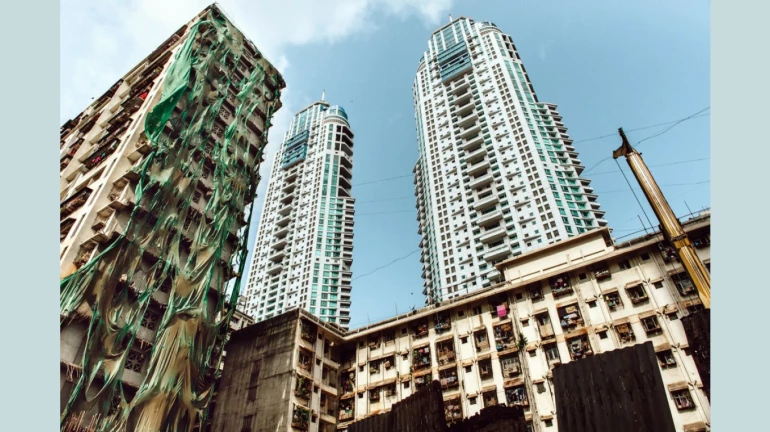


Mumbai's redevelopment market is witnessing a major transformation, with housing societies increasingly opting for large-scale neighbourhood redevelopment instead of standalone building projects.
According to a report by Knight Frank India, cooperative housing societies signed 70 redevelopment agreements covering 52 acres during the first quarter of 2026. The trend signals a shift toward cluster redevelopment, driven by supportive policy changes and the need to maximise land use in India's most densely populated city.
One of the most significant trends highlighted in the report is the increase in project size.
The average redevelopment plot area has grown from around 1,850 sq m in 2025 to nearly 3,000 sq m in 2026. More than half of the agreements signed during the first quarter involve plots larger than 10,000 sq m.
This indicates a clear move away from fragmented redevelopment toward integrated neighbourhood projects that can offer better planning, infrastructure and amenities.
Industry experts attribute the rise in large-scale projects to recent policy reforms.
Key factors include:
These measures have encouraged housing societies and developers to pursue bigger redevelopment opportunities.
Redevelopment is also influencing housing demand beyond the ownership market.
As residents move out of existing buildings during construction, demand for rental accommodation has increased. By March 2026, redevelopment-related displacement accounted for nearly 8% of Mumbai's rental demand, according to the report.
Notably, the figures cover only private cooperative housing society redevelopments and exclude projects undertaken by agencies such as MHADA and other government bodies.
Redevelopment activity remains heavily concentrated in suburban Mumbai, which accounts for nearly 95% of all projects.
Top Redevelopment Hotspots Since 2020:
| Location | Number of Projects |
|---|---|
| Borivali | 220 |
| Andheri | 115 |
| Bandra | 75 |
| Malad | 68 |
| Ghatkopar | 59 |
Other active redevelopment markets include Kandivali, Vile Parle, Goregaon, Chembur and Mulund.
At a broader level:
While redevelopment is expected to significantly boost housing supply, concerns remain about affordability and market absorption.
Knight Frank estimates that ongoing projects could deliver nearly 59,000 new homes by 2031, helping address Mumbai's chronic housing shortage.
However, a large portion of recently completed housing stock remains unsold. According to property research firm Liases Foras, the Mumbai Metropolitan Region currently has an unsold inventory of approximately 288,850 homes.
Industry observers cite affordability constraints as the primary reason behind the slow absorption of new housing supply.
Mumbai remains one of the world's most densely populated urban centres, with nearly 30,600 residents per sq km—significantly higher than cities such as Tokyo, New York and Singapore.
As redevelopment gathers pace, it is expected to play a central role in reshaping the city's skyline, expanding housing supply and driving urban renewal over the coming decade.


 Share
Share Tweet
Tweet