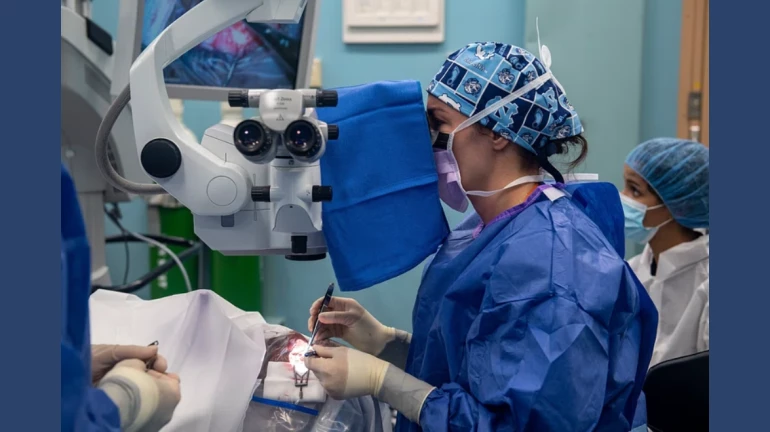


Subhash Vishnu Chache, a 62-year-old resident of Vashi, Navi Mumbai, has regained his vision after undergoing a rare and complex dual surgical procedure at Dr Agarwals Eye Hospital. He had been living with a mature cataract and a dense corneal scar in his left eye, a rare and challenging combination that had left him nearly blind.
A team of specialist ophthalmologists at the hospital's Wadala facility successfully restored his sight by performing Pinhole Pupilloplasty (PPP) along with cataract surgery.
For Chache, the loss of vision happened gradually over the years. A dense scar had formed on the cornea, the transparent front layer of his left eye, preventing light from entering the eye properly. At the same time, the natural lens had become completely cloudy due to a mature cataract. His right eye was also severely affected. As someone whose daily work relied heavily on clear vision, the impact was devastating. Everyday activities such as recognising faces, walking without assistance, and reading became increasingly difficult. Before surgery, vision in his right eye had deteriorated to the point where he could only detect hand movements, while his left eye could barely count fingers from two metres away.
After exploring multiple medical opinions, Mr. Chache visited Dr Agarwals Eye Hospital in Vashi for further evaluation. Following a detailed assessment by Dr. Pratik Yeshwant Gogri and further consultation with Dr. Vandana Jain, he was referred to the specialist surgical team at the Wadala facility for the complex procedure.
Dr. Smit M. Bavariya, Cataract Surgeon, Dr Agarwals Eye Hospital, Wadala, who performed the surgery, explained, "This patient had two separate problems obstructing his vision. The cataract was blocking light from passing through the lens, while the corneal scar was distorting whatever little light managed to enter. Simply removing the cataract would not have been enough. We therefore combined the cataract surgery with Pinhole Pupilloplasty, where we carefully reshape and reposition the pupil to make it smaller and more central. Think of it like looking through a pinhole in a piece of paper. By focusing light more precisely, it significantly improves visual clarity, even through a scarred cornea. By addressing both problems in a single procedure, we were able to give Chache an outstanding visual outcome without needing a corneal transplant."
The procedure that made this possible was developed more than a decade ago by Dr. Amar Agarwal, the renowned Indian ophthalmic surgeon and Chairman of Dr Agarwals Eye Hospital. Pinhole Pupilloplasty was developed to improve vision in carefully selected patients with corneal scarring while reducing the need for corneal transplantation, particularly in a world where nearly 20 million people are waiting for donor corneas. By creating a tiny pinhole-sized pupil, the technique blocks distorted light rays and allows clearer, more focused light to reach the retina. Clinical data from 257 patients showed vision improving from an average of 20/125 before surgery to 20/32 after surgery. Nearly 85 per cent achieved driving-quality vision, while the technique has contributed to a 15–25 per cent reduction in corneal transplant surgeries in clinical practice.
Chache's surgery lasted about an hour, considerably longer than a routine cataract procedure because of its complexity. The surgical team had to operate through a scarred cornea while also performing Pinhole Pupilloplasty (PPP), a highly specialised procedure that involves precisely reshaping the pupil to improve vision. Treating both conditions in a single surgery was a carefully considered decision, allowing Chache to avoid the risks, longer recovery time, and potential complications associated with a corneal transplant.
The outcome has been life changing. Following the surgery, Chache's distance vision improved to 6/9, enabling him to carry out most everyday activities independently, including recognising faces, watching television, and moving around with confidence. His near vision also improved to N8, allowing him to comfortably read standard print. This marked a significant improvement from the severe visual impairment he had been living with before the procedure. As part of his recovery, he has been advised to use prescribed antibiotic and anti-inflammatory eye drops, avoid rubbing his eye and strenuous physical activity during the healing period, and attend regular follow-up appointments to ensure a smooth recovery and monitor his eye health.
“I had been struggling with poor vision for a long time, and it had made even simple daily activities difficult. When I came to Dr Agarwals Eye Hospital, the doctors carefully examined my condition and explained the treatment options to me. They gave me hope and the confidence to undergo the surgery. Today, I can see clearly again, recognise faces, and move around independently. It feels like I have got my life back. I am deeply grateful to the entire team of doctors for restoring my vision,” said Subhash Vishnu Chache, the patient after the surgery.


 Share
Share Tweet
Tweet