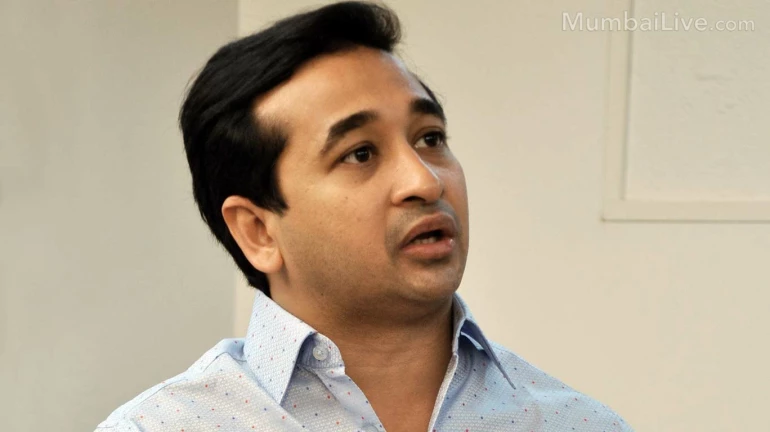


A fresh controversy was stirred in Maharashtra after a proposal was announced to rename Mumbra, a suburb in Thane district, as “Mumbradevi.” The declaration was made by Fisheries Minister and BJP leader Nitesh Rane during a public event held in Mumbra to observe the death anniversary of Chhatrapati Shivaji Maharaj. The proposed name was linked to Mumbradevi, a Hindu goddess who is regarded as the presiding deity of the Mumbra-Thane region and is worshipped by sections of the local Koli and Agri communities. Through this move, a symbolic assertion of religious and regional identity was seen to be projected.
At the event, it was stated by Rane that the renaming would follow the pattern of earlier changes carried out elsewhere in Maharashtra, including the case in which Islampur was renamed “Ishwarpur” in Sangli district. Strong political messaging was also delivered during the speech. It was declared by him that no resistance would be accepted and that the effort would continue until the saffron flag was seen on every home in Mumbra. As a result, the renaming demand was not viewed merely as an administrative suggestion, but as part of a wider ideological and cultural mobilisation.
The matter was intensified further when the proposal was connected by Rane to a broader political programme. The anti-conversion law passed by the state legislature last month was described by him as “the first step,” and it was indicated that action against madrasas could follow. Serious allegations were levelled against madrasas, and their closure was demanded. These remarks were widely regarded as inflammatory, especially because they introduced a communal dimension into an already sensitive naming controversy. In addition, criticism was directed at some Muslim leaders over earlier remarks about “turning Mumbra green” during local body elections.
It was also recalled that the renaming demand had not emerged for the first time at this gathering. Earlier, the same issue had been raised by Jain Muni Nileshchandra, who also addressed the event. He has previously been known for leading protests against the closure of pigeon-feeding spots in Mumbai by the BMC. Historical legitimacy was also attached to the renaming argument through repeated reference to the Mumbra Devi Temple, an ancient shrine located on Parsik Hill at a height of around 210 metres above sea level. The temple has long been visited by devotees from across the surrounding region, and the historical association of the town’s name with the temple was highlighted.
The political significance of the latest announcement was further deepened because similar signals had already been seen in September last year, when stickers carrying the name “Mumbradevi” were pasted by unidentified persons on railway station signboards. Because of this earlier episode, the current move by the ruling Mahayuti alliance was interpreted in political circles as a deliberate attempt to reinforce a saffron identity in the town. Thus, the issue was framed not only as one of history or faith, but also as one of electoral and ideological strategy.
A sharp response was issued by Samajwadi Party leader and MLA Abu Asim Azmi. Rane’s allegations against madrasas were rejected by him, and a direct challenge was issued asking that proof be produced. It was argued by Azmi that CCTV cameras could be installed in madrasas or representatives could be appointed if verification was truly being sought. He maintained that Islam teaches brotherhood rather than hatred and alleged that Muslims were being targeted for political gain through the spread of false narratives. On the issue of renaming, it was further remarked by him that, in an age of technological advancement, governments were being seen to focus on changing city names instead of building better and more liveable urban centres.
The controversy was widened further by another statement made at the same event. Jain Muni Nileshchandra was reported to have compared Nitesh Rane to Shivaji Maharaj and to have suggested that he could become the next chief minister. That comparison was strongly criticised by Maratha quota activist Manoj Jarange Patil. Objection was raised by him to the placing of a contemporary political figure alongside a ruler of immense historical and cultural stature.


 Share
Share Tweet
Tweet